






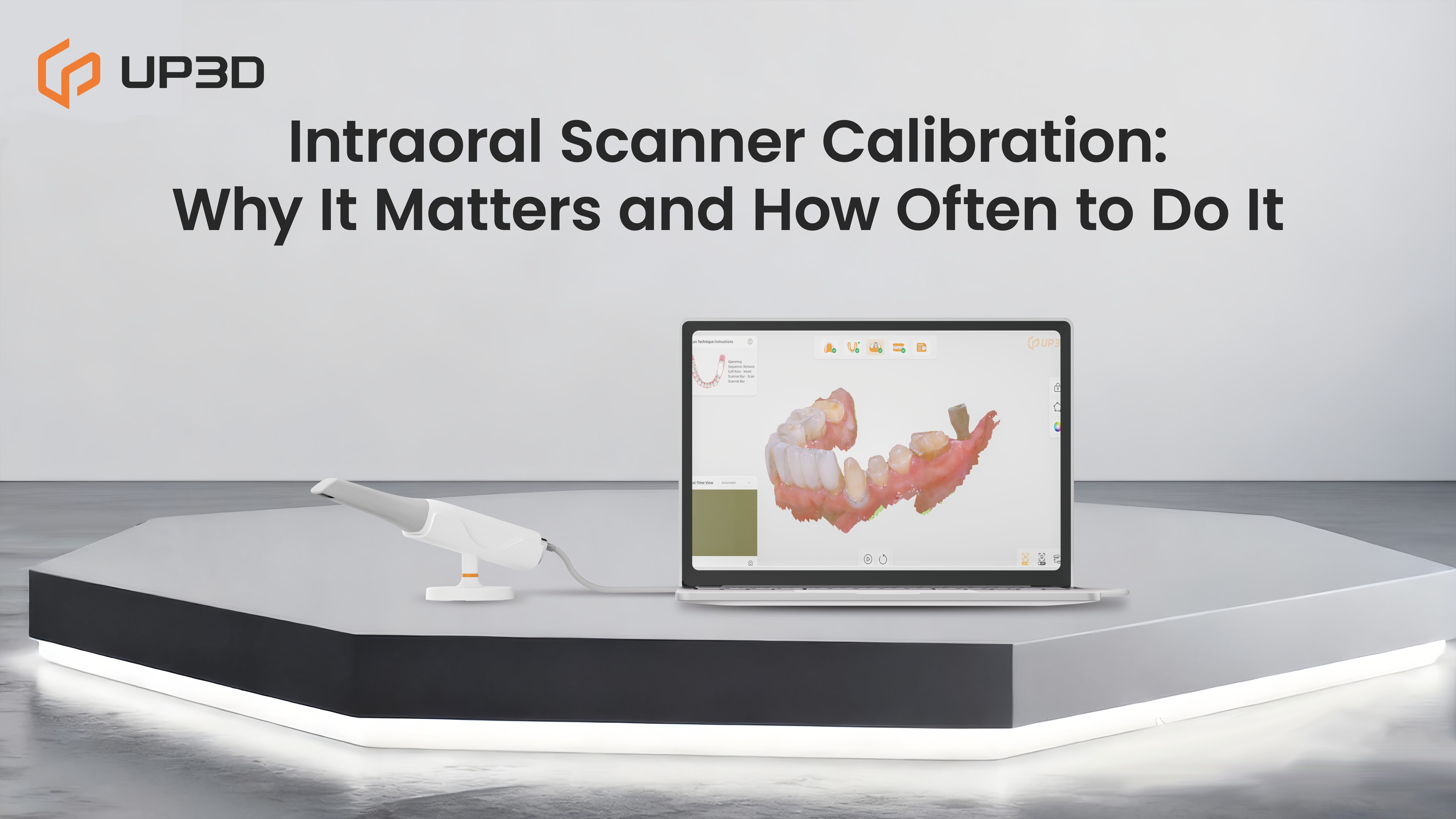
Digital dentistry depends on accuracy—and few things influence accuracy more than how well an intraoral scanner is calibrated. Even the most advanced scanner can drift over time due to daily use, temperature changes, hardware wear, or simple handling conditions. Calibration restores the scanner to its optimal performance and ensures that every digital impression reflects true clinical reality.
Yet many clinicians and technicians underestimate calibration or assume that “as long as the scanner turns on, it's accurate.” In practice, regular calibration is essential for predictable restorative outcomes, efficient workflows, and long-term equipment reliability. Here's why.
1. Why Calibration Matters in Intraoral Scanning
Intraoral scanners rely on precise optical geometry. Multiple cameras, mirrors, and light projection systems work together to measure distance, angle, and surface structure. Over time, these components may shift slightly. You may not notice this physically—but the digital data will.
What happens when a scanner is out of calibration?
-
Margins become harder to capture accurately
-
Full-arch scans show stitching errors
-
Occlusal surfaces appear distorted
-
Bite alignment becomes less reliable
-
Larger restorations (e.g., bridges) lose passive fit
-
Scan repeatability decreases
Small deviations compound quickly. A 30–50 micron drift can mean the difference between a restoration that fits immediately and one that requires multiple adjustments.
2. Signs Your Scanner Needs Calibration
Your scanner may not explicitly alert you every time calibration drifts, but the following signs often indicate accuracy degradation:
Common clinical indicators
-
Frequent rescans of the same area
-
Edges or margins appearing “soft”
-
Trouble stitching full-arch scans
-
Unexpected holes or fragmented data in the mesh
-
Changes in scanning distance tolerance
-
Restorations requiring more chairside adjustments
If these issues occur—even subtly—calibration should be repeated.
3. How Often Should You Calibrate an Intraoral Scanner?
Most manufacturers offer guidelines, but a good general rule is:
Daily
If the scanner is used continuously in a high-volume clinic or lab.
Weekly
For moderate usage and stable environmental conditions.
Whenever prompted
If the scanner's software detects drift or optical misalignment.
After any major event, such as:
-
Dropping the scanner
-
Transporting the scanner between clinics
-
Large temperature or humidity changes
-
Software updates affecting calibration modules
Modern scanners, including advanced systems such as UP3D Clariscan UP610, incorporate smart self-check mechanisms that recommend calibration intervals based on usage and optical conditions. Even with these features, manual verification is still good practice.
4. What Calibration Actually Does
Calibration is not simply a “reset”; it is a precise optical alignment procedure.
During calibration, the scanner:
-
Assesses the accuracy of its projection system
-
Verifies the position of internal mirrors and lenses
-
Measures camera relationships and angle deviation
-
Adjusts internal algorithms to correct detected drift
-
Establishes a baseline for consistent data capture
This ensures that every millimeter measured inside the mouth matches the virtual model.
5. Calibration vs. Accuracy Checks: Are They the Same?
Not exactly.
Calibration
Realigns and resets optical components.
Accuracy Check
Confirms whether the scanner is currently producing correct results, often using a test object or reference bar.
Some clinics perform accuracy checks weekly and calibrate only when a deviation is detected—but for most users, regular calibration remains the safest approach.
6. How to Maintain Calibration Over Time
To reduce calibration drift and extend scanning accuracy:
Best practices
-
Store the scanner in a stable, dry environment
-
Avoid dropping, twisting, or pulling the scanner cable
-
Allow the scanner to acclimate to room temperature before use
-
Clean the scanner tip gently to avoid scratching lenses
-
Replace scanner tips when optical clarity declines
Environmental stability is often overlooked, but temperature swings can significantly affect optical geometry.
7. Why Calibration Directly Impacts Clinical Outcomes
Calibration affects:
-
Margin clarity → fewer lab adjustments
-
Full-arch accuracy → more reliable implant workflows
-
Interproximal detail → better restorations
-
Occlusion records → fewer bite discrepancies
An uncalibrated scanner may still “work,” but it cannot guarantee predictable outcomes.
Digital dentistry is only as accurate as the device used to capture the data—and calibration is the foundation of that accuracy.
Conclusion
Calibration is one of the easiest and most cost-effective ways to ensure the long-term accuracy of an intraoral scanner. Whether you are scanning single units, full arches, or implant cases, maintaining proper calibration directly influences clinical quality, efficiency, and patient satisfaction.
As digital workflows become more integrated, reliable scanners like those from UP3D are increasingly equipped with intelligent calibration reminders and optical compensation systems—but routine operator checks remain essential.
A well-calibrated scanner is not just a technical necessity—it is a clinical advantage.


